Final book Open House again shows why experimenting is worth the effort

Photo by Basso Cannarsa
Like opening bands that’ve become significant pieces of my journey with music, Robert Coover is that to my love of fiction. Had never heard of him before a friend and I attended a reading at the 92nd Street Y. Upper East Side of Manhattan. Late 1999. T.C. Boyle was the headliner, but Coover’s progressive storytelling further opened my mind to the theory that the rules of writing are meant to be broken…or, at the very least, bent.
From the jump, his deliberate delivery of excerpts from Ghost Town was a sign to pay attention. Or else. The novel dismantles the scenes and tropes of an American Western and rebuilds them into something different. Chance is always at stake in the genre, at a card table or in a Hollywood standoff, and that right there is Coover’s mastery: Risks with characters or settings or plots might not pan gold every time, but no one ever said experimenting was an exact science.
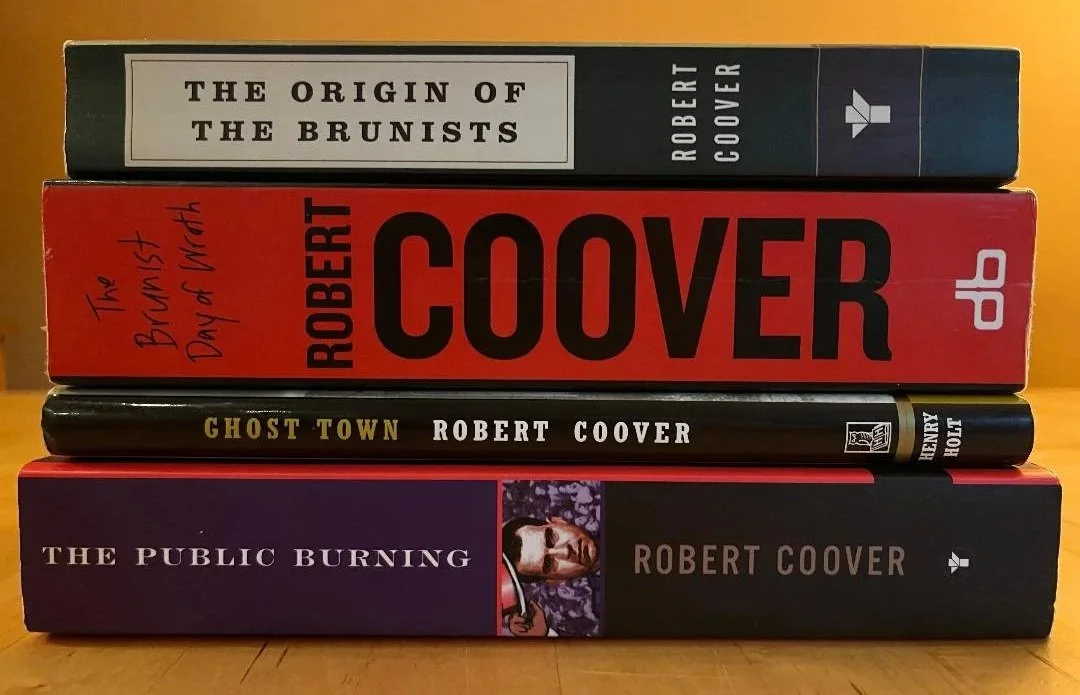
Not all his books hit or land, as the kids these days say. I’ve taken down 13 of his titles. A few were difficult even for my postmodern taste. The majority, including Ghost Town, fill the category of I Was Moved, while The Origin of the Brunists, The Public Burning, and The Brunist Day of Wrath occupy rarefied air. Where ideas and structure and vocabulary and execution coalesced into tales that’ve left a profound mark. About the blurring of reality and fantasy, the volatility of identity—and not just debunking political or religious myth but exposing it, often with bleak humor.
Which I appreciate.
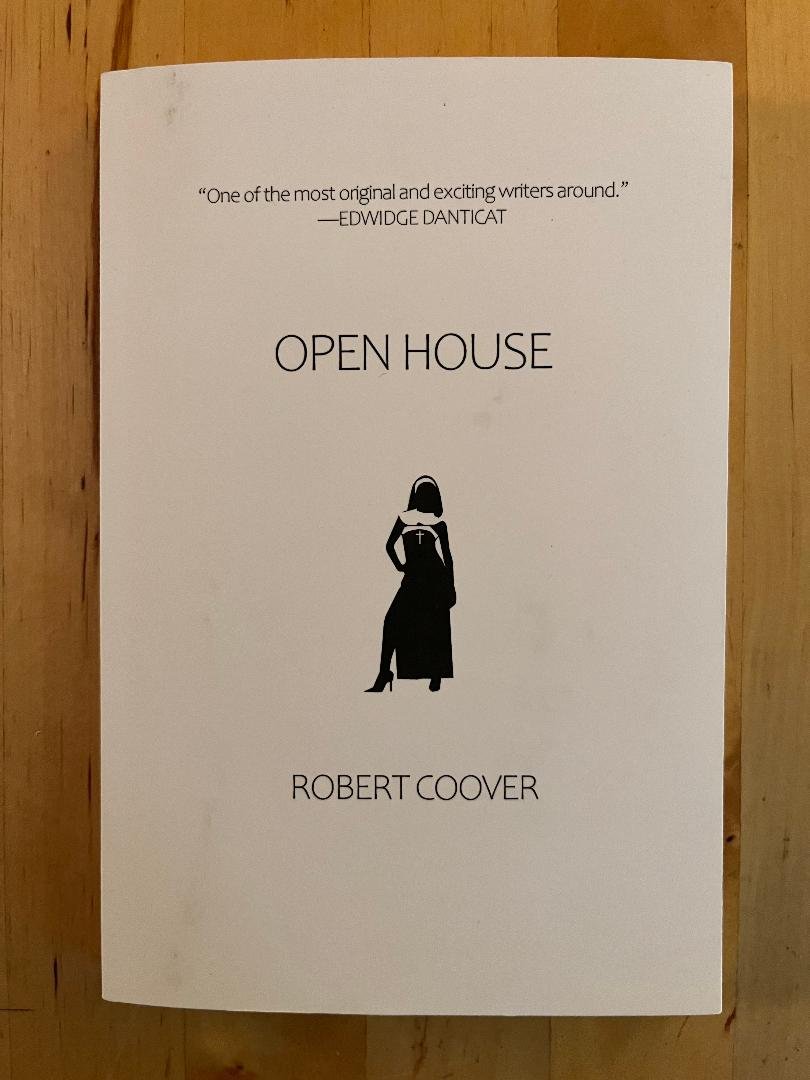
Open House represents Coover’s final published work before he passed away in 2024. It’s a fun read for those who enjoy literary adventure and iconoclastic thinking. In a Manhattan penthouse 100 floors up, with the building pitch black except for the top level, a crowd gathers. People arrive by elevator, but no one can go back down. Is it an actual open house, a high-end party, a religious assemblage, and was that a wedding? What in the hell is happening?
Combining his penchant for keeping readers on their toes with the volume of “guests,” it makes sense that Coover rotates perspectives. The honest take, and he accomplishes it within the flow of a seedy collage, even switching in the middle of a paragraph—more than twice, I had to reset. Just some of the hodgepodge of players: caterer, bartender, jazz trio, real estate agent, gangsters and con artists, artists and creatives, and a nun who acts as a sort of Where’s Waldo? throughout. Par for the Coover course, as are the over-the-top sexual encounters that tie to the theme of self-invention. Pretty heady.
No sections. No chapters. It runs from start to finish in continuous motion like the single-shot film Russian Ark. While Coover’s writing is dense and as confident as ever, the compact nature of the novella and the sheer entertainment it provides are plenty worth the time. Plus, it has a cache of the storytelling chops he’s known for. And after everything is wiped away, Open House results in an efficient last will and testament of an underrated writer with this belief: Life doesn’t begin at the edge of your comfort zone, rather it begins when you take the leap.
Risk vs. reward. I’m not talking about a wing and a prayer with the hope of impact. No haymaker in the last round to win in stunning fashion. No magic pill for a company to ingest to turn the tide. This requires logic and, if applied deftly, encourages calculated gambling that translates into real meaning, however you choose to define it. Working backward from a desired outcome is effective for prioritization. The chief benefit to me is that it’s an engine of development and evolution, for a person or a project.
I’ve been framing through the lens of risk vs. reward since my ears grew to be more discerning in late high school into early college. By my mid-20s, the same framework directed me toward the appropriate books. Musicians and authors with the skill to subvert any topic still have me riveted decades later. Challenge convention. Put the message into the universe. And, like Coover, to take chances for the story’s sake because the story is what matters most.
He’s in the Big 4 of American writers who led the metafiction movement, along with John Barth, Donald Barthelme, and Thomas Pynchon. Might be the least renowned, but he won awards, he was the T.B. Stowell Professor Emeritus in Literary Arts at Brown University, and he founded the Electronic Literature Organization. Coover was an adjunct, remaining outside the tenure system—his choice, and that sounds about right. As do the words when reading him, and when they do all come together, the dream becomes actual.